
Artwork
that Speaks to
YOU
for
YOUR
HOME
for
YOUR
beautiful space
Graphics
sculpture


-
Art History, Exhibition, Research, Shihab
Vermeer’s “Girl with a Pearl Earring” | 2024 | Presentation | Techniquest, Cardiff | UK
 Art History, Exhibition, Research, Shihab
Vermeer’s “Girl with a Pearl Earring” | 2024 | Presentation | Techniquest, Cardiff | UK
Vermeer’s “Girl with a Pearl Earring” created around 1665 CE, has been interpreted as portraying a young woman in an attire with exotic influences, potentially inspired by Ottoman court fashion. The blue turban and lemon-yellow veil-like cloth cascade from the top to the shoulders, presenting an exotic Ottoman attire from the Dutch perspective. Particularly captivating element of the painting is the substantial waterdrop-shaped pearl hanging from her ear. The segment of the pearl glistens with a golden hue, creating a vivid contrast against the shaded area of her neck. During that era, Oman and Ras Al Khaima in UAE were prominent pearl producers in the Middle East, catering to Europe’s demand for these exquisite gems.
SKU: Vermeer's "Girl with a Pearl Earring"


-
Art History, Digital Drawing, Pen Drawing, Research, Shihab
Resonance of the Caravans | 2026 | digital drawing | 4k
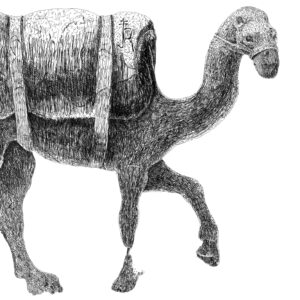 Art History, Digital Drawing, Pen Drawing, Research, Shihab
Resonance of the Caravans | 2026 | digital drawing | 4k
Resonance of the Caravans:
The Evolution of the Camel Motif in Venetian Renaissance ArtIntroduction
In Renaissance Venice, the Near East was a lived daily reality shaped by Levantine trade, diplomacy, and multicultural interaction. Within this continuous exchange, the camel became one of the Republic’s most resonant iconographic motifs. This motif originated as a static 13th-century Istrian stone relief on the facade of the Palazzo Mastelli del Cammello in Cannaregio, functioning as a commercial emblem for Levantine silk and spice merchants. Over the Quattrocento and Cinquecento, however, this artefact evolved into a dynamic element of Venetian Renaissance painting. This paper traces that evolution – from the material culture of the Palazzo Mastelli relief and the multicultural milieu of Cannaregio to the canvases of Tintoretto. Residing on the Fondamenta dei Mori, Tintoretto absorbed these local urban motifs, transforming the camel and merchant from a static trade symbol into a kinetic engine of Mannerist sacred drama.SKU: Resonance of the Caravans -
Art History, Digital Drawing, Drawing, Exhibition, Research, Shihab
John Ruskin 1885, Stones of Venice | 2024 | Presentation | Techniquest, Cardiff | UK
 Art History, Digital Drawing, Drawing, Exhibition, Research, Shihab
John Ruskin 1885, Stones of Venice | 2024 | Presentation | Techniquest, Cardiff | UK
Vermeer’s “Girl with a Pearl Earring” created around 1665 CE, has been interpreted as portraying a young woman in an attire with exotic influences, potentially inspired by Ottoman court fashion. The blue turban and lemon-yellow veil-like cloth cascade from the top to the shoulders, presenting an exotic Ottoman attire from the Dutch perspective. Particularly captivating element of the painting is the substantial waterdrop-shaped pearl hanging from her ear. The segment of the pearl glistens with a golden hue, creating a vivid contrast against the shaded area of her neck. During that era, Oman and Ras Al Khaima in UAE were prominent pearl producers in the Middle East, catering to Europe’s demand for these exquisite gems.
SKU: John Ruskin 1885, Stones of Venice -
Art History, Digital Drawing, Exhibition, Research, Shihab
Understanding and navigating transcultural dynamics between Europe and Middle East | 2024 | Presentation | Techniquest, Cardiff | UK (Copy)
 Art History, Digital Drawing, Exhibition, Research, Shihab
Understanding and navigating transcultural dynamics between Europe and Middle East | 2024 | Presentation | Techniquest, Cardiff | UK (Copy)
Understanding and navigating transcultural dynamics between Europe and Middle East | 2024 | Presentation | Techniquest, Cardiff | UK (Copy)
SKU: Understanding and navigating -
Art History, Exhibition, Research, Shihab
The Influence of the Emirates in Renaissance Art: The Journey of a Venetian Pearl Merchant to Dubai| 2024 | Presentation, Cardiff | UK
Art History, Exhibition, Research, ShihabThe Influence of the Emirates in Renaissance Art: The Journey of a Venetian Pearl Merchant to Dubai| 2024 | Presentation, Cardiff | UK
The Influence of the Emirates in Renaissance Art: The Journey of a Venetian Pearl Merchant to Dubai.
In 1590, Gasparo Balbi, a pearl merchant from Venice, mentioned Dubai and other regions in the UAE in his travelogue “Viaggio dell’Indie orientali”. Balbi was traveling through the region in search of pearls, which were highly valuable commodities in Europe at the time. Renaissance painters like Rembrandt and Vermeer frequently depicted pearls in their works. Vermeer’s “Girl with a Pearl Earring,” created around 1665, is one notable example. During Balbi’s exploration of the Persian Gulf and the Arabian Peninsula, he took note of several key locations associated with the pearl trade, including Dubai, Sharjah Ajman, Ras Al Khaima, etc in the UAE. His mention of Dubai and its surroundings is one of the earliest known references to the area, indicating that even in the late 16th century, Dubai had begun to gain prominence as a hub for the lucrative pearl industry, exporting to Europe. Balbi’s writings provide valuable historical insight into the region’s economic activity and its role in international trade long before the modern development of Dubai as a global city.
Vermeer’s “Girl with a Pearl Earring” created around 1665 CE, has been interpreted as portraying a young woman in an attire with exotic influences, potentially inspired by Ottoman court fashion. The blue turban and lemon-yellow veil-like cloth cascade from the top to the shoulders, presenting an exotic Ottoman attire from the Dutch perspective. Particularly captivating element of the painting is the substantial waterdrop-shaped pearl hanging from her ear. The segment of the pearl glistens with a golden hue, creating a vivid contrast against the shaded area of her neck. During that era, Oman and many parts of the UAE, including Dubai were prominent pearl producers in the Middle East, catering to Europe’s demand for these exquisite gems.
hashtagEmirates hashtagRenaissance hashtagArt hashtagshihabvaippipadath hashtagpearl hashtagdubai hashtagvermeerSKU: Vermeer's "Girl with a Pearl Earring"
-
Art History, Digital Drawing, Pen Drawing, Research, Shihab
Resonance of the Caravans | 2026 | digital drawing | 4k
Art History, Digital Drawing, Pen Drawing, Research, ShihabResonance of the Caravans | 2026 | digital drawing | 4k
Resonance of the Caravans:
The Evolution of the Camel Motif in Venetian Renaissance ArtIntroduction
In Renaissance Venice, the Near East was a lived daily reality shaped by Levantine trade, diplomacy, and multicultural interaction. Within this continuous exchange, the camel became one of the Republic’s most resonant iconographic motifs. This motif originated as a static 13th-century Istrian stone relief on the facade of the Palazzo Mastelli del Cammello in Cannaregio, functioning as a commercial emblem for Levantine silk and spice merchants. Over the Quattrocento and Cinquecento, however, this artefact evolved into a dynamic element of Venetian Renaissance painting. This paper traces that evolution – from the material culture of the Palazzo Mastelli relief and the multicultural milieu of Cannaregio to the canvases of Tintoretto. Residing on the Fondamenta dei Mori, Tintoretto absorbed these local urban motifs, transforming the camel and merchant from a static trade symbol into a kinetic engine of Mannerist sacred drama.SKU: Resonance of the Caravans


Showing 1–36 of 188 results


